Inquiry
Form loading...

China Top Frozen Squid Fillet Supplier Wholesale

China has become a significant sourcing base for Frozen Squid Fillet, supported by modern processing plants, skilled labor, and established cold-chain networks. Reliable suppliers usually purchase squid from managed fishing channels or verified landing ports. They then sort, clean, trim, and freeze the fillets quickly. Timing matters. Slow handling can dull the color, soften the texture, and increase drip loss after thawing.

Dr. Michael T. Morrissey, a recognized seafood science expert, offers a practical quality principle: “Good seafood quality begins with careful handling from the moment of harvest.” This idea guides serious wholesale purchasing. Buyers should examine fillet size, glaze percentage, moisture control, packaging strength, and storage temperature. A dependable China supplier should provide batch records, product specifications, inspection documents, and clear traceability. Photos are useful, but they are not enough. Physical samples reveal more.

A professional supplier also understands the needs of restaurants, distributors, supermarkets, and food manufacturers. Some buyers need uniform 200–300 gram portions. Others require skinless fillets, customized packing, or private labeling. Frozen Squid Fillet should remain firm, clean, and naturally mild after thawing. Excessive ice glaze may protect the product, but it can also reduce purchasing value. This point deserves closer attention.

The best partnership is not built on the lowest quotation alone. It depends on consistent production, honest communication, and responsive after-sales support. Even experienced buyers can overlook small details, such as carton ventilation or temperature records during loading. That is where careful supplier evaluation becomes valuable. Avaliable capacity matters, but repeatable quality matters more.
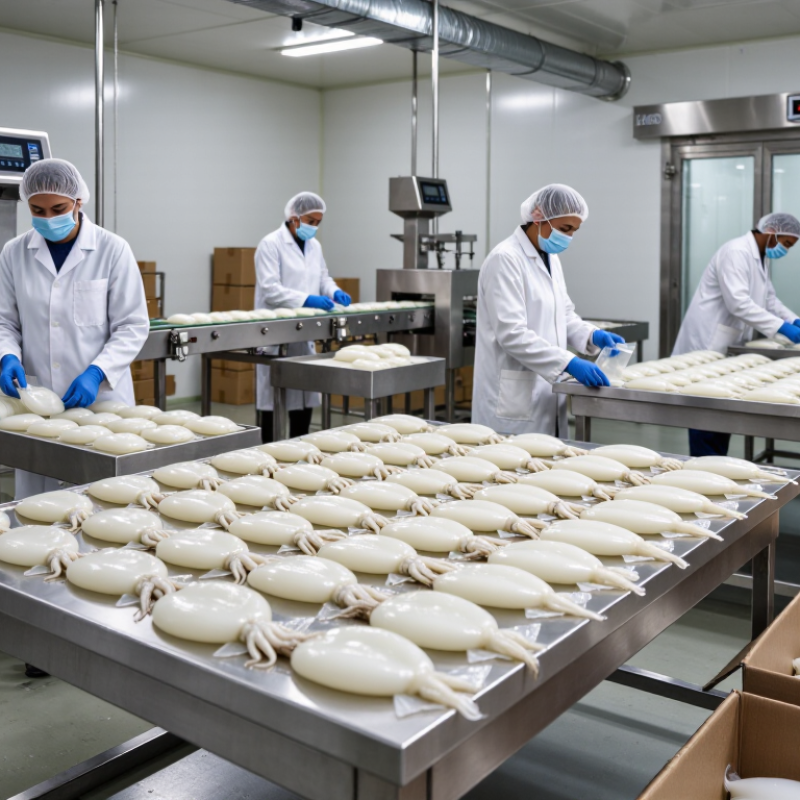
China Top Frozen Squid Fillet Supplier Wholesale

What Defines a Top Frozen Squid Fillet Supplier in China

A top frozen squid fillet supplier in China is defined by more than competitive pricing. Product consistency begins at the processing facility, where workers control temperature, trimming, glazing, and packing. Fillets should have clean edges, firm texture, and a mild ocean scent. Excessive ice or yellowing may indicate poor handling.

Reliable suppliers maintain a documented cold chain from landing or receiving through shipment. They should provide batch codes, harvest details, processing dates, size grades, and storage records. Third-party laboratory testing can verify microbiological safety, heavy metals, and other quality indicators. Clear certificates matter, but verifiable records matter more. Ask for recent documents, not recycled files.

Communication also reveals operational strength. Experienced teams explain yield, net weight, glazing percentage, carton design, and loading temperatures without vague promises. Trial orders help buyers compare thaw loss, texture, and cooking performance. Small details often expose larger weaknesses. A supplier may meet a specification once, then struggle with repeat shipments. That risk deserves honest review.

No supplier is flawless. Even careful factories can face seasonal variation, delayed vessels, or uneven raw material sizes. The stronger partner reports problems early and proposes practical corrections. Regular inspections, retained samples, and written specifications create accountability. For wholesale buyers, reliability is measured across many containers, not one attractive sample.

What Defines a Top Frozen Squid Fillet Supplier in China?

A practical 100-point buyer scorecard for evaluating frozen squid fillet suppliers, focusing on food safety, cold-chain reliability, product consistency, processing capability, and export readiness.

The weighting is a procurement framework rather than a ranking of individual companies. Food safety and traceability receive the highest priority, followed by temperature control and consistent product specifications. Frozen seafood should generally be maintained at -18°C or colder throughout storage and transport, in line with widely used international frozen-food handling practices.

Squid Fillet Types, Processing Methods, and Quality Standards

China Top Frozen Squid Fillet Supplier Wholesale

Frozen squid fillets vary by cut, skin condition, and freezing format. Skin-on fillets retain a firmer surface and stronger natural color. Skinless fillets offer faster preparation for restaurants and food factories. Common options include whole fillets, trimmed portions, strips, and interleaved blocks. IQF fillets separate easily, while block-frozen products suit high-volume processing.

Processing control begins when raw squid arrives at the facility. Skilled workers check odor, appearance, temperature, and physical damage before grading. The squid is then cleaned, filleted, trimmed, washed with controlled-quality water, and frozen quickly. Glazing protects the surface from dehydration, but excessive ice can mislead buyers about net weight. That detail deserves careful checking.

Quality standards should cover more than appearance. Reliable wholesale programs normally verify core temperature, net weight, glaze percentage, microbiological results, foreign-material control, and packaging integrity. Frozen storage should remain consistently cold, with records for loading and transport. A clean white fillet is not automatically a better fillet. Some natural color variation is normal. In practice, inspection reports, traceability records, and production samples provide stronger evidence than photographs. Specifications must also match the buyer’s cooking method, because a fillet for frying may need different thickness and moisture control than one for steaming. Perfect uniformity is difficult, and ignoring that fact can create unrealistic purchasing expectations.

How Wholesale Frozen Squid Fillets Are Graded and Packaged

Wholesale frozen squid fillets are graded by size, cut quality, color, and condition. Size is often measured by pieces per kilogram, with fewer pieces indicating larger fillets. Size matters.

A trained quality team checks uniform thickness and trimming. Fillets should have a clean surface, mild ocean smell, and natural white or pale cream color. Excessive yellowing, torn edges, cartilage, dehydration, or freezer burn may reduce the grade. Glaze percentage also matters because heavy ice can hide the actual net weight. Buyers should compare drained weight, not only the carton weight. No grading system is flawless. A small sample can sometimes hide uneven pieces in the center of a carton.

Packaging normally uses food-grade inner bags inside strong, moisture-resistant cartons. Fillets are arranged tightly to limit movement and breakage during transport. Carton labels should show product name, size range, net weight, production date, lot number, storage instructions, and country of origin. Reliable wholesale handling keeps the cold chain at -18°C or below and records temperature changes during storage and shipment. Some facilities add temperature indicators for long-distance deliveries. Clear traceability helps buyers investigate quality concerns quickly. Packaging can still fail if seals are weak or cartons absorb moisture. That detail deserves regular inspection.

China’s Frozen Squid Fillet Supply Chain and Export Process

China’s frozen squid fillet supply chain begins with approved fishing and processing facilities. Raw squid is sorted by size, cleaned, and cut according to buyer specifications. Workers check color, odor, texture, and glaze coverage before freezing. Rapid freezing helps preserve firmness and reduces quality loss during storage. Fillets are commonly packed in cartons with inner plastic bags. Clear lot codes support traceability from production to shipment.

Export preparation requires accurate product details, packing lists, invoices, health documents, and certificates of origin. The exporter must confirm destination-country labeling and import requirements before loading. Cold-chain control is essential. Reefer containers should remain at a stable frozen temperature, often around -18°C or below. Customs inspection may examine documents, packaging, and product condition. Delays can damage planning, even when the cargo remains safe. No process is perfect. A missing code or incorrect weight can create costly corrections.

Tips: Request recent product photos, size charts, test reports, and production records. Confirm the net weight, glaze percentage, carton dimensions, and loading temperature in writing. Ask for a sample carton before placing a wholesale order. Keep communication detailed. Small omissions matter. A practical supplier should explain lead times, inspection procedures, storage conditions, and corrective actions clearly. Buyers should also verify whether the proposed route has reliable refrigerated transport and suitable port handling.

How to Select a Reliable Wholesale Squid Fillet Supplier

China Top Frozen Squid Fillet Supplier Wholesale

How to Select a Reliable Wholesale Squid Fillet Supplier

Choosing a reliable wholesale squid fillet supplier requires more than comparing price. Start with species, harvest area, processing date, and production lot. Ask for a complete specification sheet. FAO’s State of World Fisheries and Aquaculture 2024 reported 185 million tonnes of aquatic animals in 2022. It also reported that 89% served direct human consumption. This scale makes traceability and cold-chain control commercially important. Request HACCP records, recent laboratory results, and proof that products stayed at -18°C or colder. Check glazing percentage and net weight, not only carton weight.

Tips: Ask for a pre-shipment sample. Measure thaw loss, fillet thickness, odor, color, and cooking shrinkage. Compare the sample with the approved specification. Confirm whether the quoted price includes glazing, packaging, inspection, and inland delivery. A low offer can hide uneven cuts or excess ice. I once focused on price and missed temperature records. That was an expensive lesson.

A dependable supplier should explain corrective actions, not merely display certificates. Verify certificate scope and expiry dates with the issuing body. For every shipment, require a lot code, catch documentation, packing date, expiry date, and container temperature record. OECD-FAO outlooks show continuing pressure on aquatic food supply and trade. Procurement teams therefore need flexible specifications and backup capacity. Still, no checklist is perfect. A trial order, inspected before full-volume commitment, reveals practical weaknesses quickly.

China Top Frozen Squid Fillet Supplier Wholesale - How to Select a Reliable Wholesale Squid Fillet Supplier
Selection Dimension Recommended Wholesale Benchmark What to Verify Why It Matters Warning Signs
Species Identification The scientific name, common trade name, and product description should be clearly stated on the specification sheet. Check the product specification, packing label, health certificate, and catch or farm documentation where applicable. Different squid species can vary in texture, flavor, yield, and market value. Only a vague description such as “squid fillet” without species or product details.
Product Form Fillets should be consistently cleaned, trimmed, skinless or skin-on according to the agreed specification, and free from excessive residual viscera. Request product photographs, a detailed trimming specification, and a pre-shipment inspection sample. Consistent preparation reduces processing waste and improves portion control. Mixed trimming styles, visible contamination, torn pieces, or unspecified skin and membrane requirements.
Size Grading Use a defined weight range per piece or a count-per-kilogram grading system, such as 10–20, 20–40, or 40–60 pieces per kilogram. Confirm the grading tolerance and compare the sample against the commercial packing list. Accurate grading supports menu costing, retail portioning, and predictable cooking performance. Wide size variation within one carton or no written grading tolerance.
Glazing Percentage A common commercial range is approximately 5%–20%, depending on the contract and product type. The percentage should be declared clearly. Confirm whether the quoted price is based on net weight or gross weight and request a glaze test when necessary. Glaze protects the product from dehydration and oxidation, while excessive glaze reduces usable seafood yield. Unusually heavy ice coverage, unclear net weight, or a price based only on gross carton weight.
Net Weight Control The declared net weight should exclude carton, inner bag, and ice glaze, and should comply with the purchase contract and destination-market rules. Review weighing records and conduct random checks on cartons from different production lots. Reliable net weight control prevents hidden cost increases and customs or buyer disputes. Repeated short-weight cartons or differences between the label, invoice, and actual product weight.
Cold-Chain Temperature Frozen squid fillets should normally be maintained at −18°C or below during storage and transportation. Review storage logs, container temperature records, and loading procedures. Stable low temperatures help preserve texture, safety, and shelf life. Frequent temperature fluctuations, thawed product, freezer burn, or damaged packaging caused by poor handling.
Shelf Life The remaining shelf life at delivery should be stated in the contract. Frozen seafood commonly requires a defined production date, best-before date, and storage condition. Check the production date, expiry date, lot number, and remaining shelf-life percentage at shipment. Adequate remaining shelf life gives importers and distributors sufficient time for customs clearance and sales. Short-dated inventory, relabeled dates, missing lot information, or inconsistent date formats.
Food Safety Testing Testing should be based on the destination market and product risk profile, including microbiological and relevant chemical or contaminant controls. Request recent laboratory reports linked to the exact product and production lot where possible. Verified testing reduces the risk of rejected shipments and food-safety incidents. Generic reports with no product identification, outdated results, or refusal to provide compliance documentation.
Traceability Each carton should be traceable through lot number, production date, processing location, raw-material source, and shipping records. Ask for a sample traceability exercise from finished carton back to raw material and production records. Traceability enables faster recalls, regulatory response, and quality investigation. No lot coding, incomplete records, or inability to identify the source of a shipment.
Packaging Use food-grade inner bags and strong export cartons suitable for frozen distribution. Packaging should prevent leakage, contamination, and crushing. Confirm carton dimensions, inner-bag thickness, carton weight, pallet pattern, and export-marking requirements. Suitable packaging reduces transit damage and helps optimize container utilization. Wet cartons, broken seals, weak outer boxes, or packaging that does not match the approved sample.
Order Flexibility The supplier should state minimum order quantity, production lead time, sample policy, and capacity for repeat orders before contracting. Compare the written quotation with the purchase order and confirm the production schedule in advance. Clear commercial terms help buyers plan inventory and avoid unexpected delays. Unclear minimum order quantity, constantly changing lead times, or inability to provide a confirmed production plan.
Quality Agreement The contract should define species, size, glaze, net weight, appearance, temperature, packaging, tolerances, and claim procedures. Use an approved product specification and retain the reference sample or inspection record. Written acceptance criteria make quality claims measurable and easier to resolve. Reliance on verbal promises or quotations that omit measurable quality requirements.
Pre-Shipment Inspection Inspection should cover random carton selection, product appearance, size distribution, net weight, glaze, labeling, and temperature. Use an internal quality team or an independent inspection service before loading. Problems are easier and less expensive to correct before the shipment leaves the processing site. Pressure to skip inspection or refusal to correct nonconforming goods before shipment.
Communication and Claims A reliable supplier should provide prompt written responses, retain batch records, and define a reasonable process for handling quality claims. Test communication during sampling, quotation, document review, and trial-order stages. Fast, documented communication reduces downtime when a shipment or document problem occurs. Unanswered technical questions, contradictory information, or failure to document corrective actions.